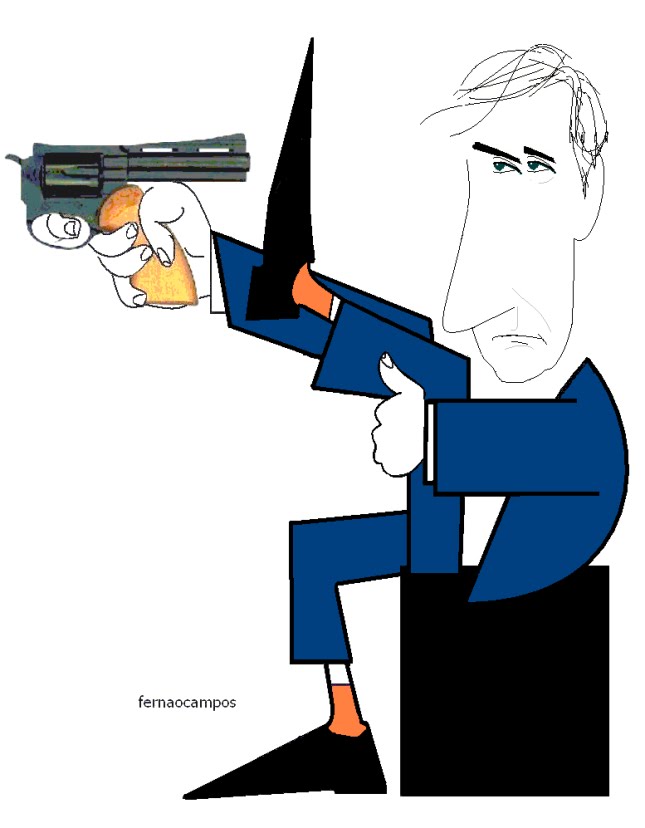
Shooting yourself in the foot may be deadly. Don't do it.
A priori this government sounds like it want to make the necessary changes.
In Brazil the PM yesterday stated:
"Our path we have to follow is a path of economic change, we must bet more on the companies, more on the opening on the economy to the exterior, more on entrepreneurship and the creativity of the Portuguese, free us from the weight of this debt - it will take time, but has to be done, to reduce the spending of the state and the public expenses"
DUH!
We need to solve the structural problems. Indeed! But when you look at what the government is doing it is astoundingly limited. Let us study what is being done for the companies. Here are the
plans:
- Workers in the private sector will work 2.5 hours more per week with no compensation
- 4-5 yearly holidays will be abolished, and bridges will be eliminated.
Is that it? No lower costs? No incentives? No smaller public sector? No lower labor costs? No more efficiency? No less bureaucracy? No better education? No better health? No lower social costs? No economic help? No way to get loans/finance? No more liberal labour laws? No more work force mobility?
I could be generous and list a few initiatives that may be the beginning of structural change and perhaps a lower level of expenditure for the public sector:
- Less PPPs, public private entity co-operations
- Privatization of large public companies
- Abolishing a large number of public entities
But which, and is abolishment just joining them together into larger fewer ones?
There are no plans to fire any public employees (as the immediate cost would be larger than the savings)
- Cutting health costs
- Cutting education costs
- Making former free highways not so
No, the government has instead insisted on creating income on the short term to live up to the public sector maximum deficit as defined by the Troika. Because the alternative is bankruptcy as Portugal would default. But would this really be so bad? Greece has technically defaulted now and will be forgiven 50% of its debt. I checked a
recent satellite image and Greece is still there.
I am very afraid the cure proposed by the PSD government is as bad or worse than the decease - if possible
Consider some of the measures Portugal will have to live with:
- Higher income tax for well to do companies
- Higher income tax for well to do people
- Less deductions income tax for all individuals and especially for well to do individuals = more tax
- Higher property taxes
- Higher levels of value added tax. The max level has been raised from 16% to 23% percent the last few years. This government does not raise the max level, but it will raise some lower level taxed products from 6% and 13% to 23%.
Here are some where it will hurt: Restaurants, cafes, entertainment, electricity and gas
- All, except the poorest, retirees (except for people associated with the devil) will loose two monthly payments per year (the 13th and 14th) for at least the next two years
- All, except the worst paid, public employees will loose two monthly payments per year (the 13th and 14th) for at least the next two years
- Everybody, except the poorest, will loose 3,5% of their income this year in extra tax. (50% taxation of the 14th salary)
- No pensions will be actualized the next two years (at least)
- No public salaries will be actualized the next two years (at least)
- Cutting health costs
- Cutting education costs
- Demanding higher levels of bank reserves
- Raising costs of public transports
The year is not over yet and we will see more measures still. 2012 and 2013 will see more yet.
I could also list what the government is not doing. But my keyboard would not be able to handle the massive input.
Anyway, the consequences read somewhat like an economics 101 recipe for disaster:
- When people have less money to spend - they spend less. Currently half of everybody in Portugal earn less 500 euros per month.
- When products become more expensive (e.g. more VAT) people buy less
- When people spend less, the companies sell less
- When companies sell less, they earn less or go broke
- When companies sell less and go broke unemployment will worsen. .
- My schadenfreude is vibrant on the news of public employees loosing income. A large group of them, the bureaucrats, deserve it. But less income to a large group of the population means, all things even, also a retraction of the economy. They will spend less
- A retraction of the economy leads, all things even, to less well to do companies and individuals
- You may have noticed that I added cutting health costs on both the list of the structural change measures and the list above. Please do show me a single economy where lowering health levels have lead to more richness? Sick people do not work very well and they are expensive in the long run. They are even more expensive when they can not be fired
- You may have noticed that I added cutting education costs on both the list of the structural change measures and the list above. Please do show me a single economy where lowering educations levels have lead to more richness? Stupid people are not much good in countries which are dependent on high tech industries and they are expensive in the long run. They are even more expensive when they cannot be fired. Stupid people tend to be worse citizens than educated people.
- Retroactive (ex post facto) laws are not popular or even illegal for a reason. You tend to distrust when words are broken and how can you have a society of law and justice when your current lawful, maybe even recommended, actions may be illegal tomorrow? Cutting pensions are surely a necessity, but it is also a retroactive measure. The current retirees have for the most part paid large shares (generally speaking 34+%) of the money reserved for them as salaries, subsidies, and social costs for their retirements mostly in the form of social security. They were guaranteed a certain pension. So much for that promise.
- The banks are currently hardly financing any companies. They will after raising reserves have even less to lend.
- Added costs for companies, such as higher property taxes and added transportation costs, does not exactly help the bottom line.
The consumer confidence index is nearing the lowest ever. The unemployment at the highest level in recent times.
IMHO the government measures are nearly all making it more difficult for the private sector. It will diminish. There will be less companies, less income, and less entrepreneurship. The economy will retract.
In Greece by now 20% of all shops have closed. I am sure soon at least 20% of all other companies will have closed as well. And it will hurt much more next year and probably the coming years... In Portugal the same will happen. When it does, we are not talking about 13% unemployment but rather 20 something percent. The Spanish unemployment is currently at 21,5%, youth unemployment over 40%. I am afraid our neighbor with a seemingly more healthy economy is showing us where we are going.
The real tragedy here is that the government when proposing its measures had certain assumptions like: 13% unemployment and a retraction of the economy of 2,8% for 2012. (I am not certain of the exact numbers and too lazy to look them up - but they are in that neighborhood). Everybody outside the government just knows it will be worse!
I beg you. Somebody give the government a calculator!
For the possible consequences could be devastating. Worst scenarios consists of decades of crisis, 30% or more unemployed, education and health sectors in ruin and private enterprise destroyed.
In the above the focus is mostly on economic issues. But this is not really where the focus ought only to be. Economy, or money, is just a means, albeit
important, to accomplish something. A thriving economy is not a guarantee for a thriving population. What is to guarantee life quality, satisfaction and happiness? A recent study pins Portuguese as some of the most unhappy of the OECD.
A huge unemployment is surely not a way to improve happiness.
I beg you. Somebody ask the government to get their priorities in order.